

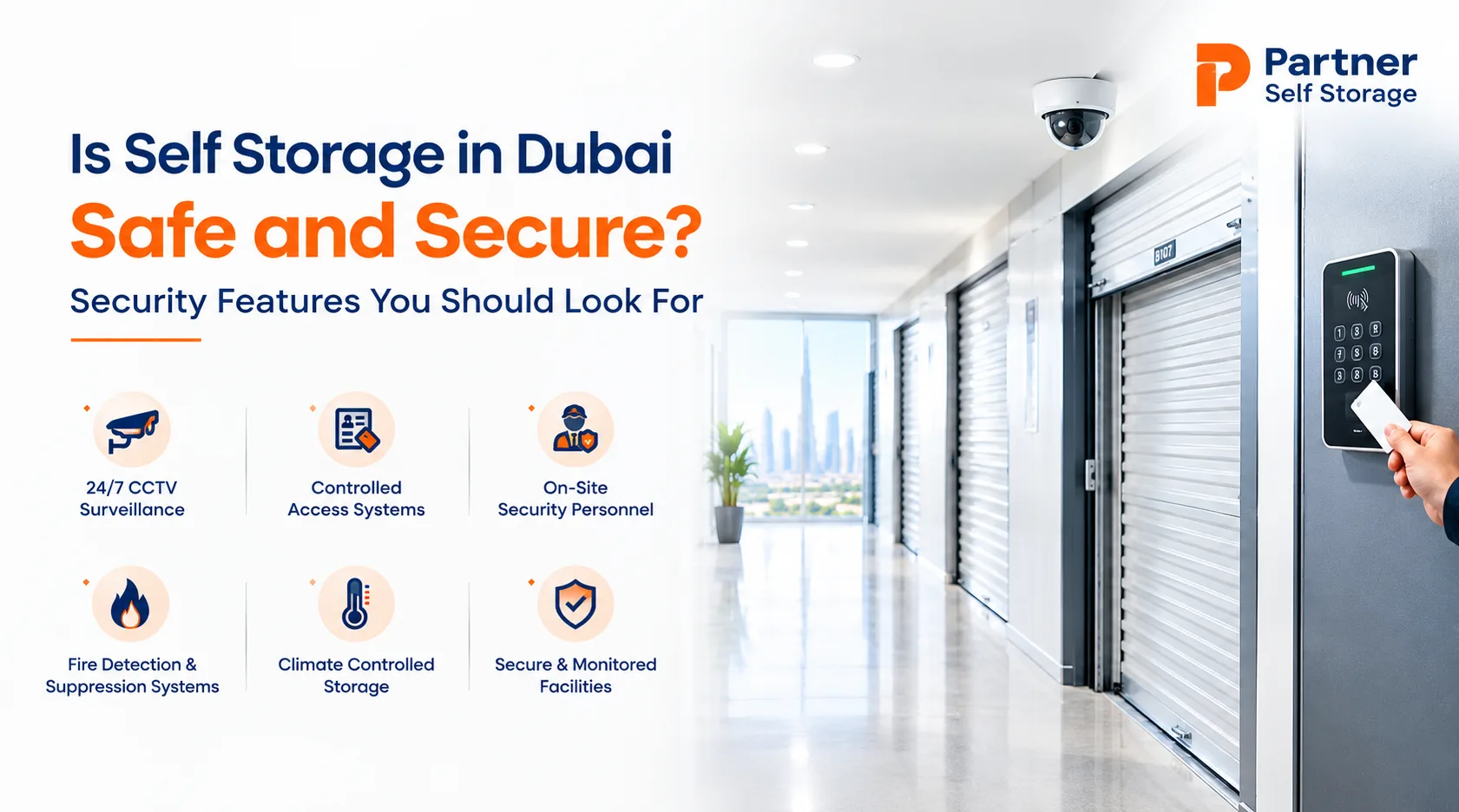
Is Self Storage in Dubai Safe and Secure? Security Features You Should Look for
When you put your belongings into self-storage, you are trusting a facility to keep them safe even when you are miles away. In Dubai, where high temperatures, humidity, and busy commercial activity add their own considerations, security involves more than simply having a lock on the door. It is worth knowing what measures a facility should have in place before you hand over your belongings.
So, is self-storage in Dubai safe? It can be, provided you choose a facility with the right security, fire safety, and environmental controls. In this blog, we will discuss the key features to look for, the questions to ask before signing a contract, warning signs to watch for, and a lot more.
How Safe Is Self-Storage in Dubai Really?
Dubai’s self-storage safety depends on both regulatory compliance and the quality of the facility’s day-to-day security controls. Dubai has regulatory requirements covering areas such as commercial premises, fire and life safety and security systems, and Dubai’s 2025 Preventive Systems Manual now includes a dedicated chapter for self-storage facilities.
However, being regulated does not make any storage facility completely risk-free. For a renter, the practical question is therefore not simply whether a facility is regulated, but how it controls access, monitors the premises, protects stored goods from fire and environmental exposure, and records who enters the facility.
Physical security is only part of the picture. Dubai’s heat and humidity also make environmental protection important, particularly for furniture, electronics, documents, and other sensitive belongings. A facility should be able to explain its security measures clearly rather than relying on broad claims such as fully secure.
Who Regulates Storage Security in Dubai?
Self-storage regulations in Dubai involve several layers of requirements rather than one single storage-security regulator. Dubai Municipality, Dubai Civil Defence (DCD) and the Security Industry Regulatory Agency (SIRA) each have roles relevant to premises, safety and security systems.
Here is what a prospective renter should understand:
- Dubai Municipality: Commercial and warehousing activities are subject to Dubai’s land-use, building and municipal requirements. Dubai regulations specifically address warehouse and storage-facility uses and related building criteria.
- Dubai Civil Defence: Fire and life-safety compliance is an important part of operating commercial premises. DCD provides services relating to safety certificates, preventive inspections, fire systems, maintenance and 24/7 smart monitoring.
- SIRA: Dubai’s security framework sets requirements for video surveillance systems, access control and other security measures. Current SIRA requirements include keeping surveillance recordings for at least 31 days and recording at a quality of at least 1080p in applicable VSS requirements.
- Federal Decree-Law No. 50 of 2022: The UAE Commercial Transactions Law contains provisions concerning public warehouses, including responsibilities relating to deposited goods and storage receipts. Article 181, for example, specifies information to be included in a storage receipt. The law also addresses the warehouse keeper’s responsibility for deposited goods under Article 179.
The 7 Security Features Every Dubai Self-Storage Facility Should Have
A secure facility should combine physical security, surveillance, environmental protection and clear procedures. These are the seven areas worth checking before you store anything valuable.
SIRA-Compliant CCTV and Surveillance
CCTV should cover relevant entrances, internal areas, and other appropriate parts of the facility rather than simply pointing one camera at the reception desk. As a useful benchmark, applicable SIRA VSS requirements include at least 1080p recording and a minimum 31-day recording period.
It is important to ask the facility the following questions:
- What resolution do your cameras record at?
- How long is footage retained?
- Who can access recorded footage?
- Are entrances and storage areas covered?
Individually Secured Units and Controlled Access
A storage unit should not depend on a generic shared locking arrangement that gives numerous people unrestricted access. Ask how your particular unit is secured and who can open it.
The current Dubai Preventive Systems Manual specifically includes security requirements for self-storage, including electric door locks, a protected securing area and systems for verifying the identity of users in relevant self-storage configurations.
If a facility offers PIN, biometric, RFID or another individual access-control system, ask how credentials are issued, changed and revoked.
On-Site Security Personnel
Electronic systems are valuable, but human presence adds another layer of accountability. Dubai’s current self-storage security requirements include 24-hour security guards for self-storage facilities covered by the relevant requirements.
When comparing facilities, ask whether guards are physically present at night, whether they patrol the premises and whether someone is available outside normal office hours.
Climate Control
Climate-controlled storage in Dubai is about protection from environmental damage as much as comfort. High temperatures and humidity can affect wood, electronics, documents, fabrics and other sensitive belongings over time.
Rather than focusing on terms like ‘air-conditioned’ or ‘climate-controlled’, ask the facility to provide its actual temperature and humidity range and explain how those conditions are monitored.
A commonly useful target to ask about is around 18–24°C and 40–55% relative humidity, although the appropriate range can depend on the items being stored. The important point is that the facility should be able to give you measurable conditions rather than an undefined marketing claim.
DCD-Compliant Fire Detection and Suppression
Fire protection should include more than a fire extinguisher near the entrance. Ask about the facility’s fire detection, alarm and suppression systems and whether the relevant DCD compliance documentation is current.
DCD’s services include preventive inspections, safety certificates and requirements relating to approved fire and alarm systems and their maintenance.
Biometric or RFID-Controlled Gate Access
A secure perimeter should make unauthorised entry difficult and provide accountability for access. Depending on the facility, this could involve biometrics, RFID cards, electronic credentials or another controlled-entry system.
Ask whether access is individually assigned, whether entry records are maintained and what happens when an employee or contractor no longer needs access.
Insurance or Other Facility-Offered Protection
Insurance should be treated as protection offered under specific terms, not as an automatic statutory requirement for every self-storage renter.
Ask whether the facility provides or requires goods-in-storage insurance, what risks are covered, the maximum claim amount, exclusions and whether you need to declare high-value items.
The 15-Question Safety Checklist Before You Sign
The features above describe what good storage security should look like. Before signing, use these questions to find out what a particular facility actually provides.
Pricing and Terms
- What is the minimum rental period?
- How much notice do I need to give before cancelling or moving out?
- Is my price locked for the agreed rental period, or can it change during the contract?
Security Specifics
- What CCTV resolution do you use, and how long is footage retained?
- How is my individual unit secured?
- Who holds spare keys, access credentials or other means of entering my unit?
Staffing
- Are security guards physically present 24/7?
- How frequently are the premises patrolled?
- Who is available at night, on weekends and on public holidays if there is an incident?
Environment
- What temperature range is maintained inside the storage area?
- What humidity range is maintained, and how is it monitored?
Compliance
- Can I see the current DCD safety/compliance documentation?
- When was the fire detection and suppression system last tested or maintained?
- What SIRA-related security-system compliance or registration applies to this facility?
Protection and Accountability
- What insurance is available, what does it cover, and what is the procedure if something is damaged or missing?
A facility that can answer these questions clearly is giving you information you can actually use to assess the storage arrangement. If the answers are vague, ask for the relevant documentation before committing.
Red Flags: When to Walk Away From a Dubai Storage Facility
Not every warning sign means that a facility is unsafe, but several together should prompt further questions or a different option.
The following are some of the red flags to look out for:
- An expired or missing DCD fire-safety certification or compliance document when the facility cannot explain its current status.
- Staff who cannot answer basic CCTV questions, such as recording quality or retention period.
- ‘Climate-controlled’ claims without actual temperature or humidity figures.
- Shared padlocks or master-key-only arrangements with no clear explanation of individual access security.
- No written cancellation policy or unclear rental terms.
- Claims that goods are ‘insured’ without documentation showing the coverage, limits and exclusions.
- Remote or unstaffed premises with no clear night or weekend security arrangements.
The key issue is transparency. A professional storage operator should be able to explain how the facility works and what happens if there is an incident.
How Partner Storage Keeps Your Belongings Secure
At Partner Storage, we combine physical security measures with a controlled storage environment to help keep your belongings protected while they are in our care. Our facilities have 24/7 manned security, CCTV surveillance and restricted access controls, supported by fire and pest-control measures and regular facility maintenance. Our storage areas are also 100% temperature-controlled and fully air-conditioned, helping protect your belongings from Dubai’s heat and humidity. Together, these measures help us provide a safe, secure and well-maintained storage environment for your belongings.
We also offer storage spaces in different sizes to suit personal and business requirements, so you can choose a space based on your needs. Our storage plans start with a one-month minimum rental, with standard monthly rentals continuing on a month-to-month basis and allowing you to cancel at any time without additional cancellation fees. For yearly contracts, we offer 11+1, where you pay for 11 months and receive the 12th month free.
Safe Storage Starts with the Right Questions
Choosing a self-storage facility is ultimately about knowing how your belongings will be looked after when you are not there. Rather than relying on broad claims about security, take the time to ask specific questions about the facility, its protection measures and the terms of your rental.
Not sure what to ask when you tour a facility? Contact Partner Storage at 800 727 8637 or visit our contact page. Our team will walk you through our security setup, climate-controlled storage and rental terms, so you can make an informed decision before you commit.

Author
pranav.k@webandcrafts.comRelated posts
Where Can I Store My Luggage in Dubai Before Check-In?
Having heaps of luggage and nowhere to store it for a few hours is a common prob
Temporary Storage in Dubai: Secure Ways to Store Your Items Before You Settle In
Traveling through Dubai rarely follows a perfect schedule. You check out of your

How to Protect Your Furniture During Home Renovations in Dubai: The Ultimate Guide
Since 2012 in the self-storage industry in Dubai, we’ve worked with hundreds o